Three months on

It is now March 2018 and I had my 3-month check recently with my orthopaedic surgeon Mr Ahmad Malik.  My progress is on track and I can now stop wearing my boot on a regular basis.  I have tried this for short periods at home but my foot feels very weak and vulnerable, though improving all the time.  It feels much stronger and secure in the boot and as a follow-up to the earlier videos here is one of walking in the boot, fully weight bearing.  My scars have healed up nicely now and my ‘purple foot sign’ mentioned in my week 5 post has now largely gone though still some swelling on the outside of my ankle, which still feels numb.  Although I am very pleased with my recovery to date, things can still go wrong.  The repair can fail but I understand that if that happens it will usually do so within a year and although normal activity shouldn’t damage the repair more extreme stresses such a running or jumping can.  Not much danger of me doing that at the moment though a gentle rumba may be on the cards soon.

My previous purple foot sign has now resolved

Fully weight bearing in Vacoped boot – note squeaking heel movement

I have been back at work for the last month but as my locum had been engaged for 3 months I was just doing clinics and meetings and organised my twice weekly physio appointments during what would have been my operating sessions.  I could get to like this life, especially not being on-call though I am missing the operating theatre, which I am now going to get back to, indeed its back to full-on work now.

The first week out of my boot felt rather odd, and I had more aching and swelling by the end of the day than when I wearing it, despite still wearing a TED stocking. For the following couple of weeks I just wore the boot on those days I did more walking at work, and left it off for the rest of the time.  Physio for me now is a mixture of stretches and manipulation/massage and more advanced hydrotherapy.

My balance and stability is the area that I can see needs the most work. It is relatively easy now for me in the pool to stand still on my bad foot for 30 secs or so, but try then twisting my upper body round, or raising my good leg sideways and I am all over the place.

The single heel raise is going to be the mark of ultimate success from this operation but that is likely to be several months away yet.  In the water at a 1m depth I can now manage a single heel raise so over the next few weeks will be working on that.  The pool has a series of 5 entry steps with side-rails rather than a ladder so standing up a step drops the water buoyancy effect a bit and will allow a progressive transition to dry land.

Picture of posh hydro pool here!
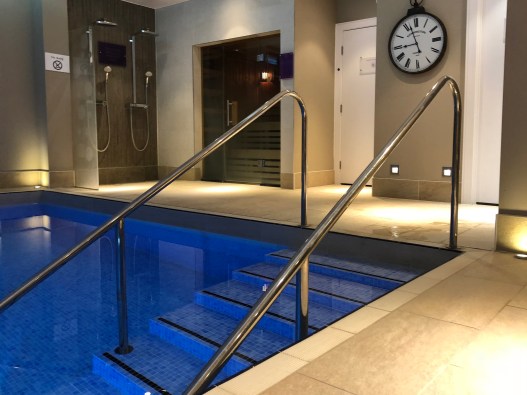
pool steps

I can just manage the heel raise one step up from the bottom but not on the second at present.  It will be a good marker of progress as I manage to move up the steps.  Isn’t it funny how such a seemingly little difference is such a big thing with this recovery, it will take weeks just to achieve these small incremental improvements.

Exercises – apart from the single heel raise I have been doing more jogging on the spot in the pool, hopping, walking sideways as well as normal swimming.  Out of the pool Owen has being getting me to work on my lateral thigh muscles to help with stability. The easiest one for this is to walk sideways with a resistance band just above the knees. Another is standing up from sitting pushing out against the same band with both knees, both whilst standing and also is a controlled return to sitting.  What I was tending to do was to allow my knees to move inwards and almost touch when getting up out of a chair. Mr Malik has suggested that in a few weeks I start making the transition from physiotherapy to a personal trainer to build more on the strengthening and conditioning exercises.  That sound rather interesting and almost a bit too posh, as I have never been anywhere near a personal trainer before.  Anyway I will update you on my progress to gym bunny status in a later post.  As they say ‘don’t try to run before you can walk”, and at the moment walking well is enough of a challenge for me.

So here are my aims for the next 3 months

Intermediate Rehabilitation Phase (12 weeks – 6 months)

Goals:

  • Independently mobile unaided
  • Optimise normal movement

Treatment:

Further progression of the above treatment:

  • Pain relief
  • Advice / Education
  • Posture advice / education
  • Mobility: Progression of mobility and function
  • Gait Re-education
  • Exercises:

– Range of movement

– Progress isolation of transfer activation without overuse of other muscles

– Strengthening exercises as appropriate

– Core stability work

– Balance / proprioception work

              – Stretches of tight structures as appropriate (e.g. Achilles Tendon), not of                     the tendon transfer.

              – Review lower limb biomechanics. Address issues as appropriate.

  • Start Lower Limb Class
  • Swelling Management
  • Manual Therapy:

– Soft tissue techniques as appropriate

– Joint mobilisations as appropriate aware of those which may be fused and therefore not appropriate to mobilise

  • Monitor sensation, swelling, colour, temperature, etc
  • Orthotics if required (new ones coming next month)
  • Hydrotherapy if appropriate
  • Pacing advice as appropriate


Rescue hens: Away from my rehabilitation my wife has just taken in 3 rescue chickens. If you don’t know about these birds, these are hens that have reached the end of their working lives as commercial egg layers and face a very short future unless they are lucky enough to get adopted by some kindly souls.  We first did this a couple of years ago and they lived for another year or so, laying well most of that time.  These hens are rehomed by the British Hen Welfare Trust (www.bhwt.org.uk).  We collected 3 out of many thousand hens ‘down on their cluck’ from Didcot, and as least saved these from being turned into cat food.

When they first arrive they look a very sorry sight, practically bald from rubbing against each other and being literally henpecked by their compatriots.  They usually haven’t been outside their ‘barn’ and were very surprised as their arrival was heralded by another short snowfall so here’s an amusing video.  They haven’t yet been accepted by our existing hens so are staying over with the ducks at the moment who are a much more amiable pair.  I will post photos later showing how much better they will look as their plumage regrows.  Ah well rehabilitation takes many forms!


Two months on

Friday 2nd February:  My first day back at work, though I have gone into the hospital 2 or 3 times in the last week for meetings and visits.  Today is outpatient clinic only, so hopefully an easy introduction and tomorrow’s the weekend!  One stick and partially weight bearing and the first time I have worn a tie for 8 weeks.

Most doctors even the senior ones don’t wear a tie any more, under the guise of infection control though I suggest that the creeping chest hair a tie keeps covered up is more an aesthetic and microbiological hazard than the tie any day.   Also it’s a difficult habit to break and I used to think that patients may have more confidence in a doctor who looked smart, rather than if he/she had just got back from taking the dog for a walk.  As for the patients now it is usually only the older ones who make an ‘effort’ to dress up a bit when coming up to a hospital clinic, a bit like going to church.  Perhaps it makes consultants more approachable if they look as if they can’t afford a decent suit, it was to make us more approachable that white coats went, first for paediatrics so as not to frighten the children though they were very useful at keeping their vomit off your clothes, and then for everyone else as hospitals realised that they could save a chunk of money by dumping uniform and laundry facilities.  The only place you will find a white-coated person in a hospital now is either in a path lab or the pharmacy.  Somewhat odd that this dumming down has not caught on in most of Europe or the States, you would expect us to have the lowest hospital infections rates in the world now, funny that.

Back to the task in hand though – a staged return to work.  Everyone was very welcoming and seemed genuinely pleased for me to be coming back.  I even got a hug from one of the nurses.   This was a multidisciplinary team clinic for prostate cancer patients, a couple newly diagnosed and the rest on treatment or monitoring.  Patients have the benefit of being seen by both myself as a surgeon, my oncologist colleague who is an expert in radiotherapy and also getting support and practical advice from one of our specialist cancer nurses.  In addition we also had a couple of medical students for part of the clinic so the consulting room was full.  It was nice to be back.

Walking around is getting easier, partially weight bearing with one crutch enables me to carry things and open doors.  That is a huge practical benefit over needing two crutches though for any distance I would still prefer two crutches at the moment.  I have taken 3 short video clips to show my progress from none to partially weight bearing, first with 2 and then only with 1 crutch.  This transition has really taken little over two weeks. Eight weeks after surgery it is unlikely that I will now damage the tendon transfer, except perhaps by vigorous resistance exercises, so progress with gradually putting more weight through my foot is just determined by how it feels.  I was a bit worried by this to start with but it just seems to come along in its own good time.


Non weight bearing


Partial weight bearing with 2 crutches.  Can limit the weight taken on your foot, increasing it with time.

Hint:  Try standing on bathroom scales with your crutches either side to get a feel for how much of your weight is going through your leg.


Partial weight bearing with one crutch.  More weight now being taken through the VACOped boot with one crutch held in the opposite arm and moving with the boot.

I am continuing with the physio in the pool at the moment but after another week or so expect to have moved out of the water and into the gym.  I do find the pool exercises (walking forwards, sideways and backwards in various combinations with and without floats), very helpful for my whole leg in general, as well as the foot.  With the water buoyancy I can walk comfortably without my boot on and getting up a bit of speed swimming is the only cardio exercise I have had since surgery.

My balance is still useless.  When I try to stand in the pool on my bad foot only, I start to topple over very soon despite trying to keep steady and flapping the floats in the water to try and keep still.  My aim is to manage one minute of one-leg standing by next week.  Owen has also given me exercises to try and build up core strength that should help with balance and posture. I just have to make the effort to do them often enough. My right shoulder, which I dislocated many years ago, has been starting to hurt a bit now, no doubt due to the extra work this arm is doing with the single crutch. Owen’s advice about that also has been helpful.

Next week I will be going into work every day for the first time, again clinics only and more meetings, as I don’t have as many of my usual excuses about workload to avoid them.


Week 6-7

Week 6

My Boot – This week as I start to weight bear I should comment about my VACOped boot, which I think is fairly unusual for most patients.

I have had this ever since I woke up from surgery 6 weeks ago.  It replaces all forms of plaster cast, and then a walking boot.  Right from the start I was able to get a bit of ankle movement as there seemed to be enough space in the boot to wiggle a little.  I could also get my foot out to clean, massage and scratch.  I can only imagine what six weeks fully immobilised in plaster does for your skin and ankle mobility.  It is heavy at just over 2kg, though perhaps that adds to the efficacy of passive exercises.  It was really just at night that I found it a nuisance but hopefully in a week or two I can take if off overnight.  In those early weeks though it kept my ankle at a right angle to prevent the achilles contracting again, and risk damaging the tendon transfer by overstretching it.

The boot comes with 2 terry liners that contain an microbead insert a bit like a bean bag.  When you remove the air in the insert with a little hand pump the liner hardens to conform to the shape of your foot and leg and is supposed to give it extra support.  There are 4 straps that you can adjust as feels appropriate, and slacken off a bit if resting with your foot up.


To begin with the ankle was locked but this week I have had the stops adjusted to give 15 degrees of movement and this will be progressively increased until I am walking in the boot with full weight bearing and a full range of ankle movement.

It still seems traditional to have a plaster cast for most patients.  In the NHS the cost of the boot probably restricts its use, but this was just added to my bill and was only a small part of it.  Most private patients still seem to have plaster also, but perhaps ask your surgeon if you have a choice as the manufacturers claim that this boot will speed your recovery by at least a couple of weeks.  From the patient viewpoint the ability to look after your skin, particularly around the incisions and to be able to keep your ankle and foot flexible whilst it is healing, must be a very major advantage over a cast.  Although I have mentioned I had up to 5 cm of calf muscle wasting I can now report that has now improved to a 2.5 cm deficit now.  That I guess is down to the early hydrotherapy.

I think the company started in Australia but a link to the UK distributor is here, and they have a video of a pretty amazing champion windsurfer recovering from a repeat fractured ankle.

VACOped web link

The VACOped boot is much bulkier than a shoe, especially with the heavy duty sole that is more than an inch thick. You will therefore walk rather lopsided which doesn’t help gait or balance so they do an ‘evenup’ foam sole that straps onto your other shoe to raise it a bit.  Oddly this isn’t part of the kit you get with the boot which I find rather odd as it is an essential accessory.  When I get walking properly in it I will upload a video so you can laugh at my efforts.

Driving – Suprisingly I haven’t missed my beloved car as much as I thought I would by now.  I am lucky in that I have an automatic and its my left foot involved.  The rules from the DVLA are clear, no driving at all of a manual car with a orthopaedic cast or boot of any sort on either foot and you can only drive an automatic if its your left foot only that is immobilised.  The risk for pedal confusion is just too great.  Even so the size of my boot means that even with it up against the left side of the footwell it only clears the brake pedal by an inch.

My first tentative drive was just up to our local supermarket in the village centre.  No problem and had my 2 crutches in the passenger seat.  On the way back to the supermarket car park, using the shopping trolley as a zimmer frame,  I met a work colleague whose wife had just had a similar operation a few days beforehand and so he was out shopping for her.  Must be more common than I had thought.  Mental note to ring her up and offer encouragement.

Week 7

January 25th – I have my next outpatient review with Mr Malik for x-rays and hope to be able to get more advice on getting back to work etc..

I am swinging confidently on 2 crutches now but my foot out of the boot still feels very weak and vulnerable.  I had quite a few x-rays taken and a lateral weight bearing film which was interesting to compare to my original films.  The pre-op film is the one with the lines on it and there shouldn’t be that much of an angle between the line of the talus (under the anke joint) and the line of my toes.  On my new film this line is much straighter and the arch is restored.


My ‘too many toes sign’ has also resolved, see the before and current photos here indicating that my forefoot has been re-aligned. Still noticeable calf wasting but have regained about a half of what I lost.


The emphasis now is on progressive weight bearing.  I am now to just use one crutch when around the house or just walking short distances and progress to walking in the boot without crutches in about another 2 weeks.  The foot of my VACOped boot was unlocked to now allow a full range of ankle movement. The other great news is that I no longer need to wear my boot at night, which I am really pleased about.  I will though need to use it whilst walking around for another 4 weeks or so.

Back to work:  I need to make plans now for a phased return to work.  Conducting outpatients clinics will be the first part of my job that I can return to and I hope to start these in a week’s time.  Walking around seeing patients on the wards will be more difficult and the unpredictability of managing emergencies does not seem feasible for me at the moment.  Before I can return to doing surgery I need to be able to stand on my left foot comfortably to be able to use both hands.  I don’t think the sight of a one-legged surgeon leaning on his crutch is going to give my patients any confidence.  I do have good team support, so am confident that it will go smoothly.  Mr Malik impressed on me that a phased return to work is important and I need to have time to continue my physio appointments and rehab exercises.

If honest though I have now had a bit of a taste of a less pressured life so it would be good to think about cutting down a bit in due course.  One of the nice things about medicine is that you don’t have to fall off a cliff at retirement but can adapt your role and job plan, service permitting, to scale down for the last few years.  The NHS can ill afford to lose its senior doctors, either in hospital or general practice, through burnout so they need to be accommodating to keep us engaged,  and productive in the later years of our careers.  Often that doesn’t seem as clear to our senior managers as it should be, especially when the service is under pressure and overly focussed on targets, rather than on the quality of service that we are providing.

My goals for the next 6 weeks:  So what am I expected to achieve over the next month or so?  This is the next section from the plan, we will have to see how I measure up to these in due course.

Recovery Rehabilitation Phase (6-12 weeks)

Goals:

  • To be independently mobile out of VACOped boot
  • To achieve full range of movement
  • Tendon transfer to be activating
  • To optimise normal movement

Restrictions:

  • Ensure adherence to weight bearing status.
  • No strengthening against resistance until at least 3 months post- operatively
  • Do not stretch transfer. It will naturally lengthen over a 6 month period

Treatment:

  • Posture advice / education
  • Mobility: ensure safely and independently mobile adhering to appropriate weight bearing restrictions
  • Progress off walking aids as able once reaches full weight bearing stage
  • Gait re-education
  • Wean out of VACOped boot once advised to do so

Exercises:

  • Passive range of movement (PROM)
  • Active assisted range of movement (AAROM)
  • Active range of movement (AROM)
  • Encourage isolation of transfer activation without overuse of other muscles.
  • Strengthening exercises of other muscle groups as appropriate
  • Core stability work – balance / proprioception work once appropriate
  • Stretches of tight structures as appropriate (e.g. Achilles), not of transfer
  • Review lower limb biomechanics

Address other issues as appropriate:

  • Swelling Management
  • Manual Therapy: Soft tissue techniques as appropriate
  • Joint mobilisations as appropriate ensuring awareness of those which may be fused and therefore not appropriate to mobilise
  • Orthotics if required via surgical team
  • Continue hydrotherapy if appropriate


Week 4-5

January 4th 2018.  Now 4 weeks after surgery and got through Christmas and New Year. Mine was rather different this year as you will have guessed.  We have a 3 seater sofa where both the outside seats recline and my 90 year-old mother in law and myself occupied these for post-prandial recovery each day over the 3 days all the family came to stay. I felt she was the more spritely and at least didn’t need my zimmer frame.

I increased my stock of books and list of films to watch and and least didn’t have to worry about the odd drink or three as I wasn’t driving anywhere. I had some cards and flowers from work colleagues, which were very sweet. Pleased that they seem to be managing fine without me.

First physio appointment.  This was the highlight this week, to meet Owen who is to supervise and encourage my recovery over the next 3 months or so. The first session was just an assessment and massage and I will start off in the hydrotherapy pool next week.

He went over proper crutch usage again as I was tending to overswing and not have the best posture so hopefully will improve here.  Scared him a bit I guess with a bit of a stumble coming down the stairs after our session but no harm done.  My right shoulder has not been quite right since I dislocated it more than two decades ago and it has come out with more minor injuries on a few occasions since, but not for at least ten years now.  Starting to ache rather more with using the crutches, hope not starting my next orthopaedic condition quite yet. Got some strengthening exercises to do.

Week 5 – In the Pool

This was a great confidence boost.  The pool is at a local retirement village in Chalfont St. Peter and part of a small gym/spa complex.  It has a full-length bar (to hold onto!) down one side, constant 1.2m depth throughout and quite warm.  I have not more than momentarily touched the ground with my foot without the boot so far, and after the first session was able to walk along the pool sideways, and backwards as well as forward.  I was using a bit more flotation that just the water with some polystyrene dumbells pushed down into the water, but at least I was walking on both feet unaided!  It did feel strange, my foot feels pretty numb especially the heel, and my balance on that leg only was hopeless but I really started to feel that I was making progress.

After the second session I could do the same without holding onto the bar, was swimming and doing some quads and calf exercises in water against resistance. Probably another couple of weeks in the pool and then moving onto the gym if I am able to weight bear fairly well by then.  I must not give up on the static exercises which although a bit boring are helping.  My calf muscle wasting has stopped and perhaps just a bit of an increase now.  I started getting some aching after the physio along the calf muscles, not in my foot, that FDL is starting to wake up.

Purple foot sign.  Another strange thing I have noticed is that if I let my foot down just for a few minutes it goes a dark colour, almost purple and start to ache but these changes reverse quickly when I elevate it again.  I guess that a similar though less pronounced process is occurring even in my boot, as I get a bit of aching if I don’t have my lower leg at least horizontal most of the time.  I have tried to capture this in photos shown below.  These changes are because the muscle pump system in the calf pushing blood back to the heart against gravity is pretty useless at the moment, fits with all the muscle wasting I have mentioned despite the static exercises as I am not walking on it.  Also there will be some reflex sympathetic nervous system changes also allowing the skin blood vessels to dilate excessively.

Well Mr Soleus, you are just going to have to buck your ideas up a bit and on advice of my physio I am going to wear a TED stocking on this leg when up on crutches to help you work a bit harder and reduce blood pooling.

My incisions are continuing to heal nicely, all the scabs have come away with a bit of gentle soaking, oiling and moisturising.  All quite comfortable now though still rather numb. This is to be expected as the tiny sensory nerves under the skin will have been cut and take many weeks to re-establish connections. Two photos here of my scars at the 5 week point.

The aim for next couple of weeks will be to progress with physio enough to start to weight bear, back to driving, and planning a phased return to work at about 8 weeks.  Lets see how it goes


Week 2

December 21st

I am now two weeks after surgery and went back to see my consultant.  The cuts are all healing well and not much swelling so dressings now off, suture ends trimmed and back in the boot.  I am to take my foot out of the boot to do passive exercises, and will start with my physiotherapist at the 4-week point, concentrating on hydrotherapy first.

I can also start to get my foot wet.  I am sticking with the bath, which I prefer to showers anyway now that I’m not in a rush. I was able to get in safely from just a few days after surgery, and then lift my foot up over the side resting on a stool placed alongside the bath with a pillow covered by a towel to get to the right height. Luckily our bath taps are in the middle but depending on which foot is affected you might be battling with the taps. I then use the hand shower on our bath just to wash over my foot and soften the scabs without soaking the wounds, which are still pretty fresh, and then pat dry. I am using a moisturiser and some Bio-Oil to massage in around the scars.

Our shower was retro-fitted so there is a five inch hop up to get in and no grab rails. If we had a shower that was easier to get in to, then an old stool to sit on would work. I have read though that most of the early post-op accidents with people who have had foot surgery seem to be related to them slipping in a shower so I will stick to the bath for some time yet, and you don’t have to get a waterproof cover for your cast or boot, which you would need for a shower.

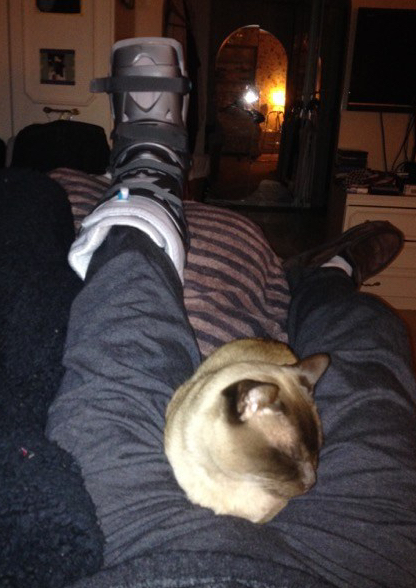
Its still very early days but I am feeling my progress is fine. I am not taking regular painkillers any more, usually just a couple of paracetamol last thing at night. I’ve got used to the nightly ritual of the heparin injections to reduce the risk of deep vein thrombosis but find it awkward to sleep with the boot on, no doubt I will get used to it as I guess its going to be my friend for at least a couple of months more. Trying to spend less time in bed where one of our cats has adopted me as his favourite place to be.

cat
Captive audience for our cat

Muscle loss – It is frightening how much calf muscle wasting I have had. Before surgery the affected calf was about 1cm less in circumference as I had been limping for a while. Now just 2 weeks later the difference is a whopping 5cm, though the other one calf may be have got a bit bigger due to all the hopping I have been doing with my zimmer frame that I use in preference to crutches still for moving around the house.

Moving about. I have heard good things about the kneel-on scooters, which you can hire from StrideOn for about £19 per week (Other knee scooter are also available). They seem particularly good if you need a free hand to carry a drink or food, which is a major challenge using a zimmer or crutches. Luckily I have help at home and coming up to Christmas our children are around a lot more as they are now back from university. I can make a cup of tea then slide it along the worktop, hopping after it and then do a swing over to the kitchen table. Dry items I just carry in a bag slung round my neck. The knee walker is probably also invaluable if you need to get out early after surgery to the shops, but I am hoping to avoid doing this. I anticipate that I will be able to start progressive weight bearing after 4 weeks or so when I will need crutches so decided to forgo this gadget. If you think it could be right for you though details from their website below.

www.strideon.co.uk

Whilst surfing I found a great blog by Paul Gee describing his recovery from similar surgery to my own nearly 4 years ago and he was an enthusiast for the knee scooter (see entry for ‘Day 1 – The Surgery’)

mybigflatfoot.blogspot.co.uk

I will write again after Christmas and the New Year to report on progress.  I fear that I will be even more useless around the house than usual.  Managed to get the outside Christmas lights up just before my operation but the rest of the decorating and planning for the wider family invasion on Christmas Eve will be down to the others.  Anyway I should look on the bright side – no working, no driving so plenty of opportunity for some of those bottles of good claret I have in the back room.


Surgery – Day 1 & 2

So dawned the morning of Thursday Dec 7.  I was dropped off at the local Spire Hospital by my wife who was off to Jury service, more about that bad timing later, settled into my room quickly, and seen by Mr Malik and my anaesthetist. After a couple of hours it was a short hop along the corridor to theatre and although I have seen this process hundreds of times in my own patients, going to sleep is still a little scary but a marvel of modern surgery.

That instant of the anaesthetic infusion taking rapid effect, I was concentrating on a mark on the ceiling above me and seeing it start to blur and move around – then waking up a couple of hours later in the recovery area. Unlike natural sleep when you wake up realising that, hopefully, a large period of time has elapsed since you fell asleep; with an anaesthetic you are essentially in a coma, unaware of any passage of time, it could be minutes, hours or for some patients seriously ill in an intensive care unit days or even weeks. You just wake up with no sense of the passage of time, and these days almost never in pain. Loaded up with class A drugs, local anaesthetic blocks numbing my lower leg and foot most effectively, I felt dreamily comfortable and content. This had to be better than doing my own operating list that would have been scheduled for that time in my normal week! Later it was really nice to see my family and I felt pretty good.

The first night was restless. Mainly I was kept awake by the noise and activity of the mechanical calf compression device I had on my other leg. I got used to its varying cycles of compression cycles some slow, some fast but all noisy. I don’t usually sleep on my back so it was unusual anyway, but fixed with one foot in a big boot and the other in the compression device was quite immobilising. I was glad to see the sunrise through my window, breakfast was great including scrambled eggs with smoked salmon more decadent than I ever get at home!

I was then introduced to my new best friend, a zimmer frame, with which I learned to hop about the room, really just between the bed and the bathroom. You soon realise after any surgery that previously minor everyday tasks are much more difficult. Going to the toilet is one, though in my job I was worried about having difficulty myself peeing but luckily it was all right, though the hopping to the toilet with a zimmer, then manouvering my left leg to kneel on a stool by the loo to keep my foot up took some practice to get the aim right. With all the anaesthetic drugs, painkillers, pre-operative starving and immobility constipation is inevitable but luckily sorted itself out in a couple of days at home.

The first day after surgery my surgeon went through the operation and I was pleased to hear that it had all gone as expected – a couple of pictures here and I am really sorry if you are squeamish, better not look!

My ruptured TP tendon

The FDL tendon transfer being prepared

If you would like to see a detailed video of the type of surgery I had then the link is here. It is a full surgical teaching video from a commercial source, so be warned!

flat foot reconstruction (video) from Arthrex

I was to try and keep my foot above the level of my heart for at least a week for a minimum of 50 min every hour. That essentially meant confined to bed and just up for loo breaks. After that if I sat in an armchair my left foot should be above hip level to minimise swelling. I found out very soon that even if I let my foot hang down for just a few minutes then it started to ache and I was glad to get back to bed and put it up again.

Not everyone will recover at the same rate, there is quite a range and I am constantly reminded of this when I review my own patients after surgery. Some bounce back as if nothing had happened, others take much longer. Part of course is your pre-existing fitness level and also the extent of surgery required. Flat foot correction surgery is a big thing for your poor foot to go though and will take many weeks of steady graduated exercises and physio to improve. I was dismayed that it may likely be 6 months before I would get back to gently jogging again, and 9 months for ballroom dancing, by then I expect that my wife will have given up on me and found another partner; we will have to see.

Crutches.  The hospital physiotherapist got me up on crutches, I had never done this before and was told off for trying to go too fast, the last thing you need is a slip and a fall. I stayed in hospital 2 nights, but managed to disconnect the pneumatic calf pump for the second night so slept much better. I was to give myself heparin injections to reduce the risk of blood clots every night for 6 weeks after surgery. Pushing the needle in didn’t hurt but the drug would sting for a short while after.

I had plenty of painkillers and the block that my excellent anaesthetist had put in to numb my foot took nearly 2 days before it had worn off. The second morning my physio was back to teach me how to go up and down stairs on crutches. That was not so easy and it was clear that a good bannister rail is a must to do this safely and I might well be better off just sliding up and down on my bum, at least to start with at home. Then it was goodbye to the staff and off home sitting sideways across the back seat of the car. Then straight upstairs which involved an ungainly one footed bum-shuffle and into bed with my leg up on pillows above heart level, but not obscuring the TV.

Pre-op

Practically every surgical patient over the age of 50, scheduled for an anaesthetic and anything other than minor surgery will need a general heath screen and a few tests beforehand.  In my case this involved a medical history check, blood and urine screen a heart tracing (ECG), and some skin swabs.  These pre-op checks were well organised in a single visit to the hospital and unlike the queues I have previously experienced in NHS hospitals, especially for blood tests where I have been behind 20 other souls, it all was done in half an hour or so.

There was a snag though, my skin swabs grew staph aureus.  Fortunately though this was not the resistant superbug often in the news (MRSA), that can cause havoc if it gets into the body, but a more sensitive strain (MSSA).  I was half expecting this as I am sure most people who work in hospitals are unknowing carriers of these bacteria and I had been tested positive for MRSA in the past.

The eradication regime of nasal cream, as most of the carriers are in the nose, and daily chlorhexidine shower gel/shampoo was not new to me, and I diligently did this for 5 days, finishing the day before admission, particularly scrubbing away at my affected foot such that it practically glowed.

It was a mad rush to get everything tidied up enough for my anticipated 8 weeks or so off work.  I am not good at admin so I was burning the midnight oil at my hospital for the last few days finishing reports and letters, and checking that there would be adequate cover, though that wasn’t sorted until the last moment as we had no suitable applicant for the first locum adverts.  That’s unfortunately often the way for small specialties in the NHS at the moment.  I also had to close down my own private practice though my part-time secretary would be able to fend off queries as needed.  Finally the night before surgery I got home very late, but prepared for the task ahead.

What next?

I wasn’t put under any pressure to have surgery but as a surgeon myself it was clear that this wasn’t getting better and all the future promised was a worsening of symptoms, and development of arthritis in the distorted foot bones over the next year or so, which would than be more difficult to then treat and probably involve fusion of foot and possible ankle bones to prevent the damaged joint surfaces rubbing against each other. I already had the nickname Mr Limpy, from my dear colleagues, the rats, so the die was cast.

Surgery it had to be.  This I was told would involve removal of the inflamed remnant of the tibialis tendon beyond where it had snapped and replacing it with a tendon transfer using a small muscle close by intended to bend the toes down, the flexor digitorum longus or FDL for short.  The damaged spring ligament supporting my arch would need repairing and strengthening with an internal synthetic fibertape brace.  To realign my foot I needed the large heel bone cut in two, the top bit moved about a centimetre allowing my foot to point forward again and not to the side and then fixed in its new position with a metal plate and some screws, that’s a calcaneal osteotomy.  Finally my calf muscles seemed tight from months of limping so he recommended an achilles tendon lengthening as well.

I also sought a second opinion from another respected ankle surgeon who agreed with Mr Malik about the diagnosis and proposed treatment plan. As a patient you shouldn’t feel reticent about asking for a second opinion, no self-respecting and competent surgeon will be offended by that and of course you will hopefully get the added reassurance that you are on the right track.  That of course can take time to arrange in the NHS, which is probably why most patients don’t ask, but a second opinion can be easily arranged privately, just ask your GP for another recommendation or do your own research which is usually quite easy.  I also had the advantage of knowing the local orthopaedic surgeons but I didn’t want one of my immediate colleagues to have the burden of having to treat me.  From personal experience, although it is an honour to be asked by other doctors to treat either themselves or their family members, if it’s a major condition there is increased stress, in doing so.  Also I am only too well aware that sometimes things don’t always turn out as well as hoped for, not due to anyones fault necessarily, and to see my surgeon frequently in the same hospital might be awkward.  I felt it important to be treated as a ‘normal patient’ by someone who didn’t know me and that decision to put myself in Mr Malik’s hands I am sure was the right one for me.

Why private? I chose the private sector for several reasons.  I spend 90% of my working time in the NHS and see daily the pressures the service is under.  This is worse now than for several years and particularly at winter time lots of routine operations get postponed because all the bed are filled with emergency and urgent cases.  I didn’t want to be one of those statistics as any delay would play havoc with my arrangements for being off work, my locum cover and other matters.  Also I believe that those who can pay for treatment should do so, to take at least some pressure off the NHS, indeed a lot of routine operations are now being carried out by private hospitals, not a practice I really approve of however.  We did have medical insurance for many years but with the children being dropped off the policy when they reached 18 years and BUPA significantly raising the premiums a year ago we decided to drop it, not perhaps the best decision I have made as things turned out.  Never mind, I often joke with my more elderly patients that if they put their insurance premiums into an ISA they could have a decent operation every couple of years and still come out on ahead, so now I had to practice what I preached.